


Engineering companies can improve hiring outcomes and workforce performance by adopting a proactive workforce strategy rather than relying on reactive recruitment. This includes skills-based hiring, forecasting future talent needs, building specialist talent pipelines, and using workforce data to identify skills gaps, optimise costs, and improve workforce planning. Effective contingent workforce management gives the flexibility to respond to changing project demands while maintaining compliance and control. Combined with a strong employer value proposition (EVP) and employer brand, these strategies help engineering businesses attract scarce talent and build a workforce that supports long-term growth.
Main Insights:
- Engineering companies can improve hiring outcomes by implementing strategic workforce planning and reducing reactive recruitment.
- Develop specialist talent pipelines and skills-based hiring strategies to help overcome skills shortages.
- Effective contingent workforce management improves flexibility, controls costs, and strengthens compliance across projects and regions.
- Use real-world data to identify skills gaps, optimise resource allocation, control labour costs, and make better hiring decisions.
- Having a strong EVP and employer brand helps attract and retain in-demand professionals.
The engineering sector operates in a complex workforce environment, marked by ongoing skills shortages in key technical areas, demanding project pipelines, stricter compliance standards and pressure to manage costs more effectively.
While the immediate response might be to increase recruitment efforts to address hiring issues, attracting new talent alone rarely addresses underlying issues in overall workforce processes. Delays in filling roles, rising contractor spend, inconsistent workforce planning, and difficulties in retaining professionals all point to wider strategy challenges than just a shortage of candidates.
As engineering businesses continue to balance permanent employees, contractors, and project-based specialists, organisations are adopting a broader approach to workforce planning, improving hiring success and building a model that supports long-term business growth.
Why are engineering companies struggling to hire the talent they need?
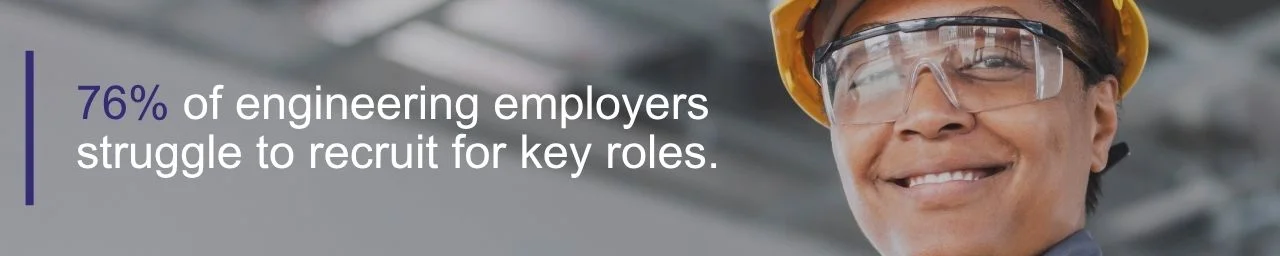
It’s common for engineering companies to compete for the same limited pool of talent while, at the same time, managing changing project requirements, new technologies, and shifting workforce expectations. Research from the Institution of Engineering and Technology found that 76% of engineering employers struggle to recruit for key roles, especially in technical and sustainability-focused disciplines.
These are some of the top factors contributing to ongoing hiring difficulties in the sector:
1. Global engineering skills shortages & competition
Engineering talent is in high demand across sectors, including energy, infrastructure, manufacturing, and renewable energy and technology. Specialist fields face long periods of unfilled positions, leading to project delays and resource shortages.
The World Economic Forum predicts significant changes in workforce skill requirements by 2030, highlighting the growing need for businesses to plan ahead of hiring rather than react to direct shortages.
This demand then leads to a frequent mismatch between supply and expertise, causing businesses to compete globally for individuals with sector-specific technical knowledge.
2. Project-based workforce models
Another issue is that engineering companies generally experience inconsistent hiring cycles throughout the year. Capabilities cover the full project lifecycle, start to finish, so workforce requirements fluctuate according to different development stages and client demands.
Without effective planning, businesses can find themselves rushing to secure talent at very short notice, often leading to increased costs.
3. Increasing reliance on contingent workers
Contingent/contract workers have become an important segment of the engineering workforce because they provide specialist expertise required for complex projects and support operational flexibility.
Even though their flexibility can offer advantages, managing a growing contingent workforce can introduce additional challenges to hiring practices, including concerns around governance, compliance, and visibility if appropriate controls aren’t in place.
4. Rising workforce costs
Contractor rates, agency fees, onboarding expenses and workforce administration costs are only going up with inflation and economic pressures and can increase considerably when hiring is also reactive.
If you don’t have visibility into workforce spending, you might struggle to understand how resources are allocated and identify opportunities for cost optimisation, which can put pressure on hiring budgets and project margins.
5. Compliance and worker classification challenges
Global engineering companies frequently engage workers across multiple regions, especially when specific project milestones happen in certain countries before moving on to others. This can lead to complexities around employment regulations, worker classification requirements and local compliance obligations.
What is workforce consulting for engineering businesses?
Workforce consulting helps engineering companies assess, optimise and future-proof their workforce strategy to improve hiring, control costs, increase compliance and support long-term business goals.
Unlike traditional recruitment methods, workforce consulting takes a broader view of how talent is managed across the business, from planning through to retention.
Through advisory and consulting expertise, businesses gain a clearer understanding of their workforce structure and the actions needed to improve performance. NES Advantage can help you evaluate multiple aspects of workforce performance, including:
- Workforce strategy design and optimisation
- Contingent workforce management
- Project-based hiring
- Worker benchmarking and market rate analysis
- Workflow diagnostics
- Finance and cost control processes
- Technology reviews and system optimisation
- Legal and compliance guidance
- Employer of Record (EOR) solutions
- Talent community development
- Employer Value Proposition (EVP) marketing
How business advisory & consulting improves hiring outcomes
Improving your hiring outcomes requires more than simply sourcing new candidates. It depends on visibility, planning, workforce data, access to talent, and how your business presents itself to the market.
Improving workforce visibility
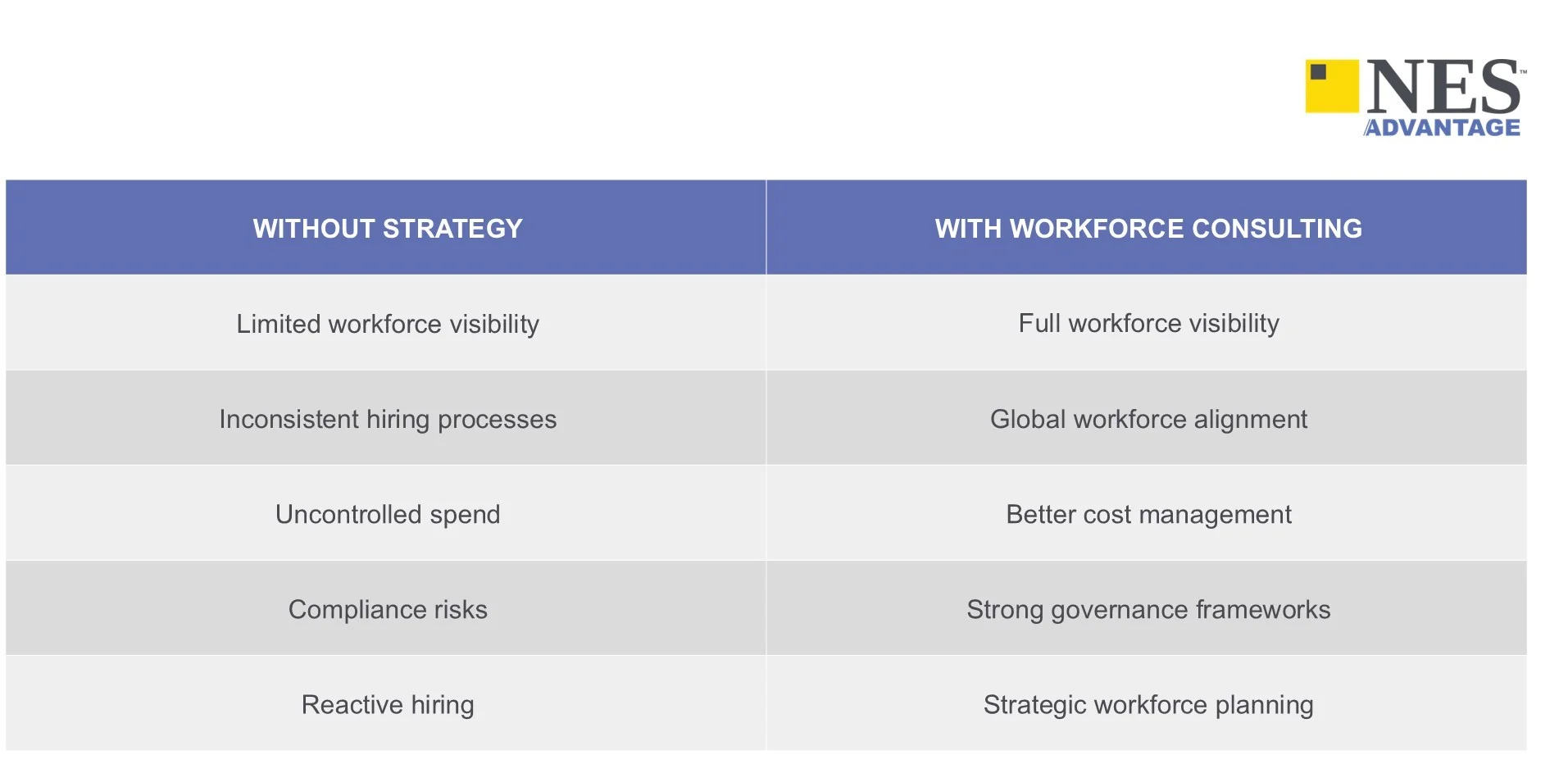
Many engineering companies don’t have a complete view of their workforce, particularly regarding external or contingent labour, making it difficult to answer simple questions such as how much is being spent and where contractors are deployed.
Workforce consulting helps to:
- Understand total workforce spend across regions and projects
- Identify where contingent workers are located and in what roles
- Highlight gaps, overlaps, and inefficiencies in resource allocation
For example, you might discover that multiple business units are engaging similar contractors at different rates, creating unnecessary cost variation.
Building better workforce planning
Reactive hiring is one of the biggest barriers to effective recruitment. When hiring decisions are made under time pressure, quality and cost can suffer. A structured workforce strategy enables you to:
- Forecast future skills requirements
- Identify upcoming resourcing gaps
- Match talent strategies with project schedules
- Reduce last-minute hiring activity
- Improve workforce utilisation
Instead of waiting for talent shortages to occur, you can proactively prepare for future workforce needs with greater confidence.
Improving access to specialist talent
Access to niche engineering skills is a consistent challenge across industries and regions. Our consulting solutions help businesses create stronger talent pipelines through:
- Talent communities for hard-to-fill roles
- Workforce market intelligence
- Global talent networks
- Skills mapping
- Strategic workforce planning
These approaches identify and engage skilled professionals before project demand peaks.
Strengthening employer brand and EVP
Technical professionals now have more career choices than ever. They can select from diverse roles, higher salaries, better benefits, and workplace flexibility. Businesses that communicate a compelling EVP are generally better positioned to attract sought-after talent.
A strong EVP can help you to:
- Engage passive candidates
- Improve candidate quality
- Enhance candidate experience
- Strengthen workforce retention
- Support long-term talent attraction
Combined with effective workforce planning, employer branding becomes an important part of improving hiring outcomes.
What are the benefits of an effective contingent workforce strategy?
As engineering companies increasingly rely on flexible labour models, having a defined contingent workforce strategy becomes essential. A well-designed approach to contingent workforce management delivers numerous advantages:
- Greater workforce flexibility: Businesses can respond more effectively to changing project requirements while maintaining specialist expertise.
- Faster mobilisation: Established workforce processes and talent pipelines allow you to secure resources more efficiently at critical project stages.
- Cost benchmarking: Understanding contractor rates and workforce costs helps you make more informed decisions and improve budget control.
- Improved governance: Clear workforce processes support consistency across departments and locations.
- Better workforce classification control: Structured governance frameworks help reduce regulatory risks associated with worker engagement.
- Reduced compliance risk: Workforce reviews can spot compliance gaps and strengthen controls surrounding external workforce engagement.
- More accurate workforce forecasting: Reliable workforce data supports planning decisions and helps you anticipate future resource requirements.
What should you look for in a workforce consultancy & advisory partner?
Choosing the right consultancy partner has a direct impact on the success of any workforce initiative. Not all providers offer the same depth of expertise or level of support.
Key factors to consider include:
- Proven experience within engineering environments. Workforce challenges within engineering are often very different from those found in other industries.
- Look for consultancies that apply a structured methodology tailored to your organisation's goals.
- Clear focus on measurable, tangible business improvements such as reduced costs, improved hiring performance, better compliance outcomes, etc.
- Ability to deliver services globally and support international workforce models.
- Strong understanding of workforce technology and software (like CRM, VMS, and ATS systems).
- Comprehensive knowledge of compliance and global labour regulations.
- Ongoing support beyond initial implementations to ensure improvements are embedded and sustained.
How are workforce consulting and recruitment evolving?
Workforce management is changing as businesses place greater emphasis on efficiency, data, and outcomes.
Some of the top trends include:
- AI-enabled workforce planning is improving forecasting and decision-making.
- Skills-based hiring is expanding talent pools, moving away from traditional qualification requirements and focusing on demonstrated skills and capabilities.
- Flexible workforce structures are becoming more common.
- First-hand data and workforce analytics are providing more in-depth insights into performance and costs.
- Business leaders expect workforce strategies to be supported by evidence, making consulting engagements more outcome-focused.
How NES Advantage Can Support You
NES Advantage is a world-leading workforce solutions provider, operating in over 45 countries and providing specialised services to the engineering and technical sectors worldwide. Our business advisory and consulting solutions help you to understand and future-proof your workforce. We ensure workforce initiatives deliver meaningful business value while supporting broader organisational goals.
Get in touch with us today and find a bespoke solution for your next challenge.