


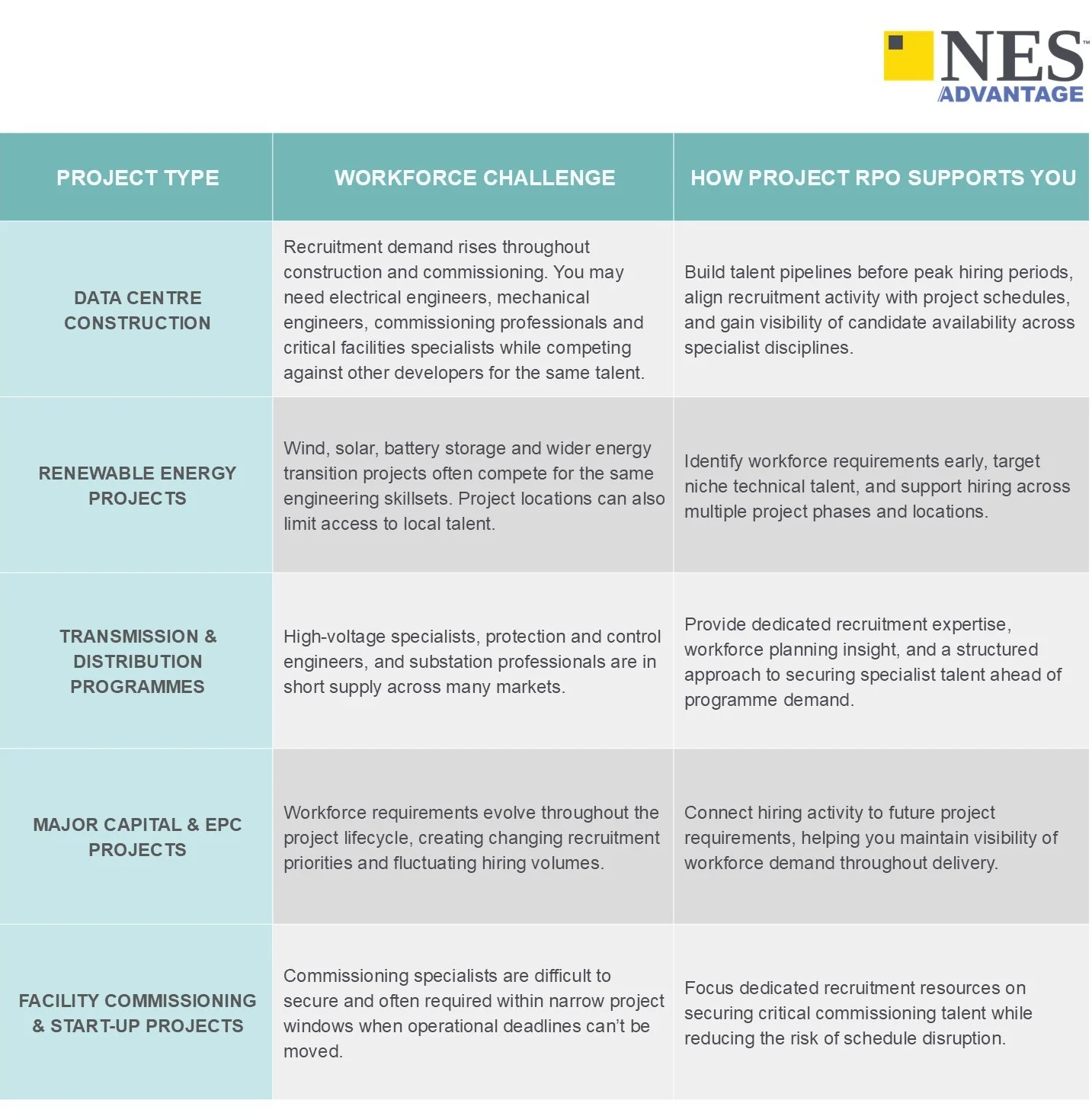
Engineering and energy projects that benefit from Project RPO are those with defined hiring goals, fixed completion dates, specialist workforce requirements, or large recruitment campaigns linked to a specific programme of work. Data centre developments, renewable energy installations, grid infrastructure programmes, major capital projects, and commissioning activities tend to fall into this category. They require large numbers of technical professionals within a relatively short timeframe, yet the talent market is highly competitive.
Main Insights:
- Project RPO works best when you need to deliver a defined hiring programme against fixed project timelines.
- Engineering and energy projects often face skills shortages alongside high-volume hiring requirements, creating pressure on internal recruitment teams.
- A dedicated Project RPO team helps you build talent pipelines ahead of demand, reducing the risk of recruitment delays affecting project delivery.
- Project RPO is particularly effective for data centres, renewable energy developments, grid infrastructure programmes, major capital projects, and commissioning activities.
- By connecting workforce planning to project milestones, you gain greater visibility of hiring progress, candidate availability, and potential risks.
You may find your internal recruitment team under pressure when workforce demand suddenly exceeds normal business-as-usual hiring activity. And if you're hiring for an engineering or energy project, you're competing in one of the toughest talent markets on record.
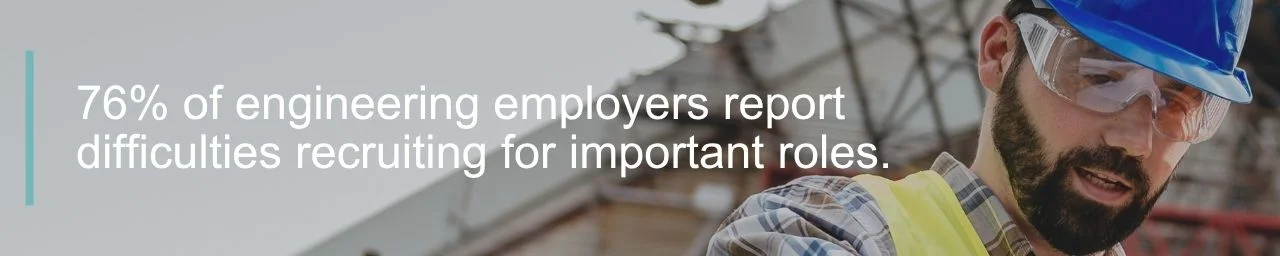
The Institution of Engineering and Technology's 2025 Skills Survey found that 76% of engineering employers report difficulties recruiting for important roles. CEWD also states that the energy sector will require around 32 million workers over the next decade, including approximately 81,000 electricians annually. Combined with trillions of dollars of investment across clean energy, grid infrastructure, nuclear, storage, and electrification, securing specialist talent is becoming a major delivery challenge.
Against this backdrop, many organisations face a straightforward question. How do you build the workforce needed to deliver a project when competition for professionals is already intense?
For projects with defined hiring objectives and non-negotiable deadlines, Project RPO is often the answer.
What is Project RPO, and how does it work?
Project RPO is designed for organisations facing time-bound hiring requirements with a clear outcome. It's a form of Recruitment Process Outsourcing that supports a specific workforce objective with a defined scope, timeline, and clear start and end. Instead of a long-term ‘enterprise’ model that covers ongoing recruitment activity, this solution focuses on a particular project, site, or growth phase.
- A dedicated RPO recruitment team is set up to support your specific engineering or energy project,
- The team operates as a complement to your existing HR function, embedded alongside project stakeholders,
- Processes, tech, reporting, and workforce planning are tailored to the project plan, not BAU hiring,
- The engagement concludes once hiring objectives and mobilisation milestones have been achieved.
What makes a project a good fit for Project RPO?
1. Large volume hiring requirements
Many engineering and energy projects require workforce mobilisation on a scale that exceeds normal recruitment activity. Infrastructure upgrades and multi-year construction schemes, as well as growth phases in energy, such as new plants or large renewable parks, generally create concentrated hiring surges.
Managing recruitment at this level can be challenging for smaller internal teams that support routine business hiring. Candidate sourcing, screening, interviews, and stakeholder management take up a lot of time and resources, and when these suddenly increase, bottlenecks start to appear.
2. Specialist skills shortages
Across the industry, employers face persistent skills gaps, which makes recruitment even tougher on top of volume hiring. Specialist sustainability and technical skills cause the greatest difficulty, including commissioning engineers, project controls professionals, HV specialists, and technical project managers, who are in high competition.
These difficult-to-source roles need more than traditional recruitment methods; you can’t just fill vacancies as they arise. Project environments rarely allow hiring teams to recruit reactively. You need visibility of niche talent markets beforehand. Project RPO supports this through targeted sourcing strategies, talent mapping, and access to pre-qualified technical professionals across specialist disciplines such as SCADA, high-voltage power systems, and commissioning.
3. Fixed project deadlines
Large-scale projects typically work to immovable milestones and against carefully managed schedules. The operational aspects of the projects are planned before workforce requirements become urgent, but this makes pre-emptive hiring activities even more critical. Delays in recruiting can trigger project-wide issues, which, in turn, are linked to operational and financial risks. When talent gaps hold back the schedule, the risk quickly rises.
Project RPO gives you increased visibility of your workforce requirements and access to recruiters who understand time-bound hiring and the demands of project phases. Recruitment risks are identified earlier and then planned for accordingly.

4. Multiple locations or international hiring
Global energy and engineering organisations frequently need to hire across multiple sites, countries or regions. But recruitment spanning different labour markets introduces additional challenges around candidate availability, compliance requirements and local hiring practices. And consistency becomes particularly important when projects require similar skills in different geographies.
This is an area where dedicated project recruitment delivery can provide substantial value, particularly with RPO providers that have established global expertise.
Types of engineering & energy projects that benefit most from Project RPO
Building a data centre? Explore how Project RPO can support your hiring strategy in Why Choose Project RPO for Your Data Centre Build?
Case Study: How Project RPO supported the creation of a global engineering hub
A useful example of how Project RPO can support complex engineering projects comes from NES Advantages’ work with a client establishing a new global engineering hub in Kuala Lumpur, Malaysia. The facility was being established to support Engineering, Procurement, Construction and Installation (EPCI) activities for floating offshore projects and would require more than 200 new hires across engineering and corporate functions.
The client had no local office, no established talent acquisition function, no existing candidate network and no employer brand presence within the Malaysian market. At the same time, hiring activity needed to move quickly to support ambitious project timelines.
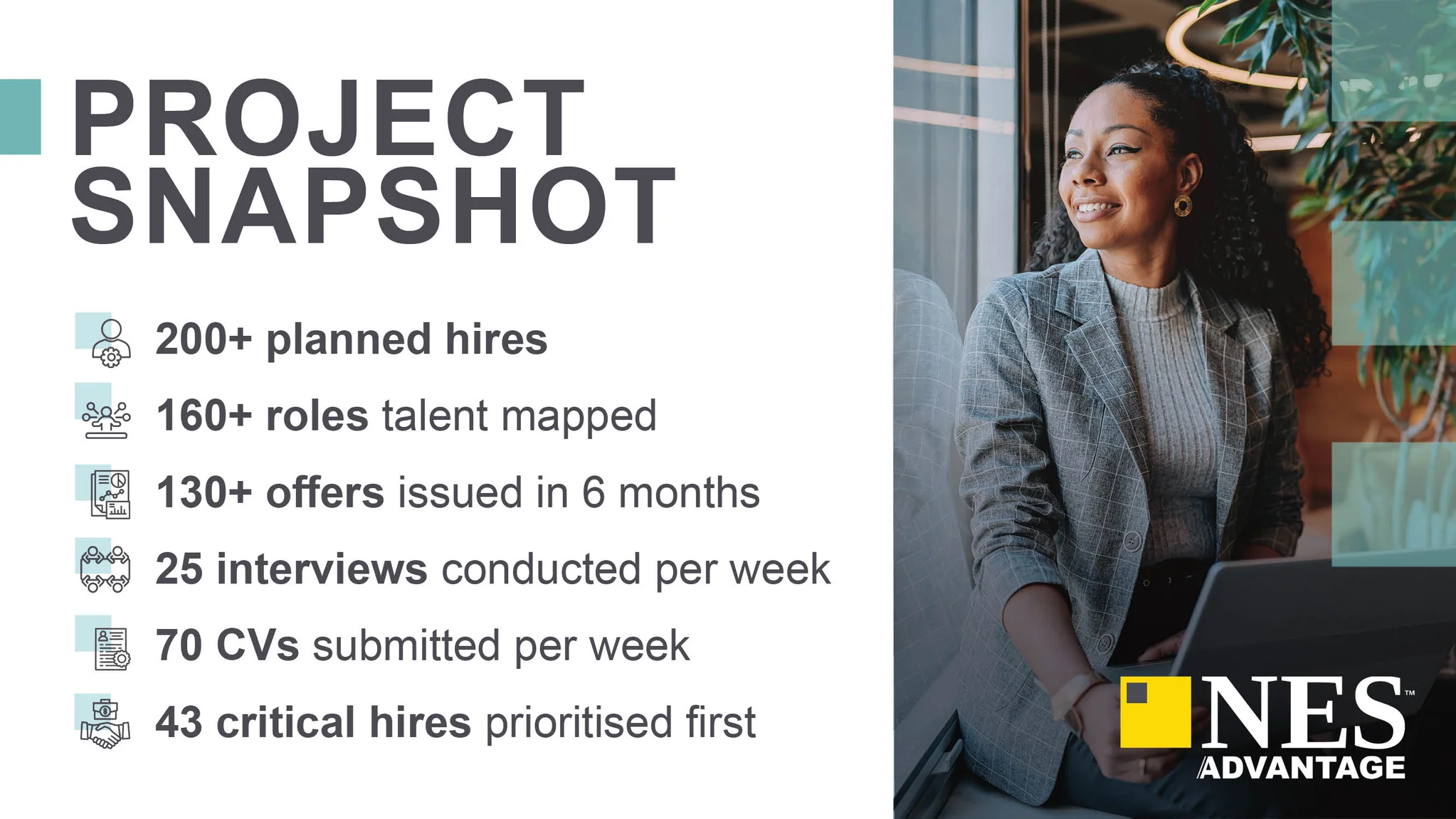
We implemented a dedicated Project RPO solution that combined talent mapping, recruitment process design, sourcing support, employer branding activity, and end-to-end recruitment management. The programme covered more than 160 roles across engineering and business support functions, giving the client access to local market expertise while creating the recruitment infrastructure needed to support long-term growth.
The project highlights why Project RPO is often used for large-scale engineering programmes. Read the case study in more detail here.
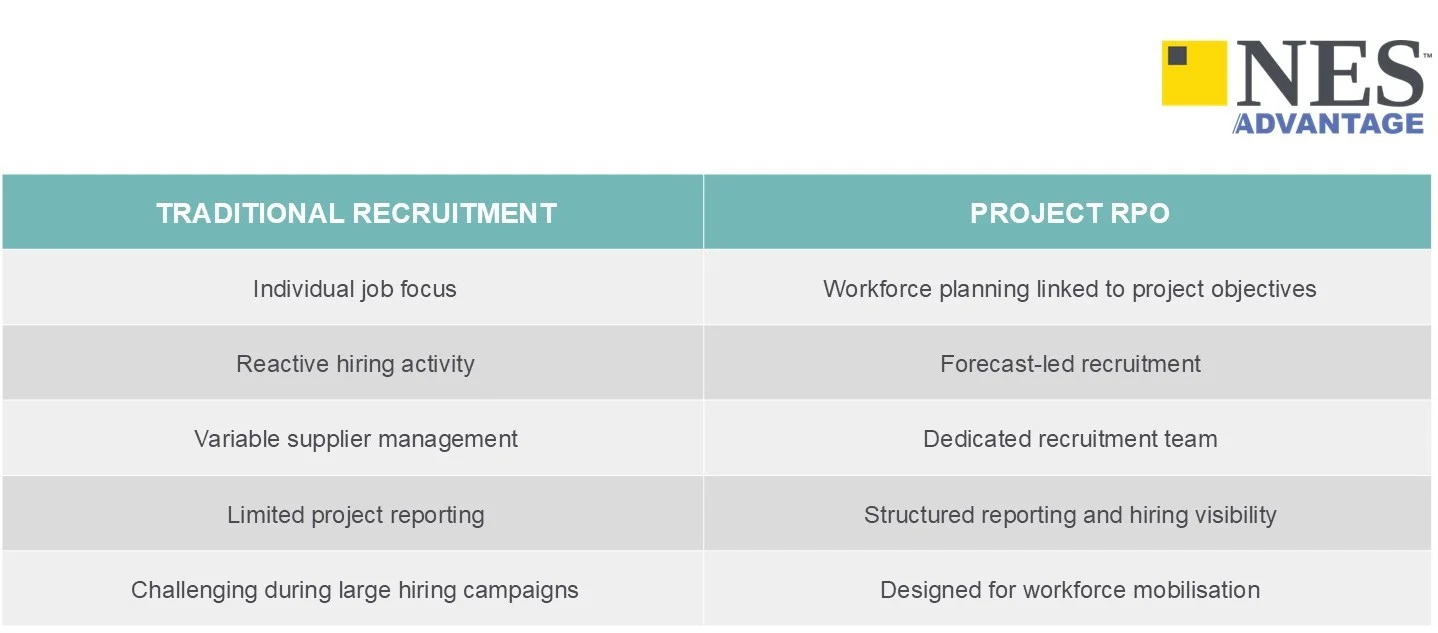
Why traditional recruitment isn’t enough
Although traditional recruitment is effective for business-as-usual hiring, such as single hires and predictable workforce demand. Project hiring requires a workforce strategy that connects recruitment activity with delivery objectives. Project RPO provides that structure.
Is Project RPO right for your next project?
Project RPO may be worth considering if you need to:
- Hire multiple technical specialists within a defined timeframe
- Support workforce mobilisation for a major project
- Recruit across multiple countries or locations
- Access specialist engineering talent that is difficult to source
- Improve recruitment visibility and workforce reporting
- Align hiring activity with project milestones
- Reduce reliance on multiple agencies
- Increase recruitment capacity during periods of peak demand
If your project involves any of the characteristics above, Project RPO can provide the recruitment capacity and expertise needed to keep delivery on track.
Many businesses adopt this model as a strategic way to start with a single project and then expand it to other areas of the business once they see successful results.
Deliver Your Project with NES Advantage
With more than 50 years of experience supporting technical industries, NES Advantage understands the workforce challenges that accompany large-scale engineering and energy projects. Our Project RPO solutions are tailored to sectors including power, renewables, data centres, and construction and infrastructure, giving you access to specialist recruiters, established talent networks, and local market expertise across the globe.
Ready to transform your recruitment strategy? Contact us today to learn how Project RPO can help you achieve your hiring goals.
People also ask:
Which RPO model fits my business?
The right RPO model depends on your hiring volume, internal recruitment capacity, and workforce objectives. Learn how Enterprise, Project, Hybrid, and On-Demand RPO compare in our guide.
How does Project RPO streamline hiring?
Project RPO gives you a dedicated recruitment team focused on a specific hiring objective, helping you secure talent efficiently while maintaining visibility throughout the process. Explore the full process in our blog.
Why should I invest in Project RPO?
Project RPO provides specialist recruitment expertise without increasing permanent internal headcount, making it a strong option for project mobilisation and hard-to-fill technical roles. Discover the top 5 benefits.