


Data centre companies are facing a tough hiring market, competing for talent within a limited set of traditional pools. Introducing DEI (Diversity, Equity, Inclusion) recruitment strategies and reconsidering how roles are advertised and assessed reaches outside of those traditional candidates. Women, career returners, ex-military professionals, disabled professionals, older workers, and specialists from adjacent technical sectors all bring valuable capability to data centre teams. If your current recruitment process only looks for candidates with an established data centre background, you could be overlooking people who also have relevant skills.
Key Takeaways:
- Women account for around 8% of the global data centre workforce.
- Around 21% of UK data centres have no women in technical roles.
- The global data centre workforce needs to reach roughly 2.3 million professionals to operate facilities, with operators reporting difficulty recruiting and retaining qualified people.
- Gender and ethnically diverse teams are more likely to financially outperform less diverse peers.
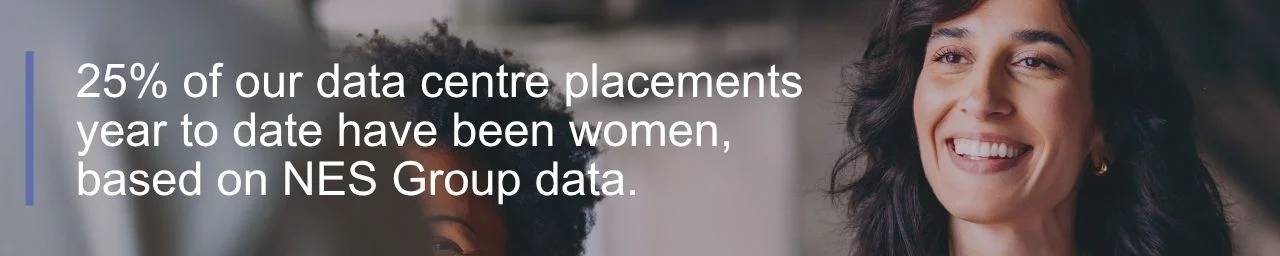
- Our data shows that 25% of our data centre hires year-to-date have been women.
The talent shortage is also a recruitment problem
Data centres require a large workforce in order to safely and reliably keep their complex systems running. This workforce consists of engineers, electricians, mechanical specialists, commissioning professionals, project managers and facilities teams, as well as all the other technical and professional roles needed throughout the asset's lifecycle.
The demand for these skills is placing pressure on businesses, with more than half having difficulty filling open positions and one in four having seen staff recruited away by competitors. The workforce also suffers from a gender imbalance, as women roughly represent around 8% of the workforce, a figure that has changed little since 2018.
It’s clear that many projects need more people, but many are still recruiting from a restricted network of familiar profiles. In the U.S., the data centre sector needs 340,000 workers that it can’t find, as candidates are often expected to have direct data centre experience, a specific job title and a conventional career history. But this reasoning excludes people who have the technical ability to perform well but have developed experience in another setting. If one of the requirements on the job description is “five years of data centre experience”, these candidates may never reach the first stage.
DEI hiring solutions can be one way to address this issue, but it has to be regarded as part of workforce planning and development.

The data centre sector is missing capable people
Women are a clear example of an underused talent pool, making up a fraction of the global data centre workforce, lower than their representation in other traditionally male-dominated sectors such as construction, mining, and manufacturing.
Research conducted by the UK Government on diversity in the technology sector provides another useful benchmark. Although women account for about 21% of technology teams, 21% of data centres have no women in technical roles at all. Disability representation is also said to be 14%, although this figure can be influenced by a lack of confidence in the support available in the workplace, just as is the case with neurodivergent people's responses.
It should also be noted that recruitment and retention are related: although many women are employed in the tech industry, almost 1 in 3 intend to leave due to issues such as career advancement, work-life balance, and workplace culture. Simply improving outreach will not address the fundamental problem if the work environment does not provide good reasons for people to stay.

"When organisations talk about talent shortages, I often ask whether they're facing a shortage of people or a shortage of people who look exactly like those they've hired before. Some of the skills data centres need already exist in adjacent industries, among career returners, ex-military professionals, disabled talent and people whose experience doesn't fit the traditional mould. The challenge isn't always finding talent. It's recognising it." – Katy Hall, Head of Diversity at NES Fircroft
Are you hiring for skills or for familiarity?
The numbers given above don’t suggest a shortage of aptitude but point to difficulties in attraction and retention. While women represent a small percentage of the global data centre workforce, according to NES Group placement data, 25% of our data centre placements year to date have been women. This suggests that the challenge isn't necessarily a lack of available talent, but whether recruitment processes are giving that talent an opportunity to be identified and assessed fairly. Individuals may decide not to apply to a role because they don’t see anyone like themselves in the organisation. They might also avoid roles that appear to demand an inflexible schedule, a physically demanding work environment, or a career history they don’t recognise as relevant.
Women can face additional barriers when a workplace or sector is perceived as male-dominated. Some commentators have even described parts of the data centre industry as "short-staffed boys' clubs", highlighting concerns around representation and workplace culture. While a job advert can’t solve every cultural issue, it can affect the kind of people who feel inclined to apply.
The same principle applies to other groups that may be overlooked during recruitment:
- Career returners may have strong technical experience but a gap in their CV
- Ex-military professionals may have transferable skills that aren’t experienced in data centre terminology
- Disabled professionals may need reasonable adjustments during recruitment or on-site
- Older workers may bring extensive engineering knowledge while being screened out by assumptions about career stage
- Neurodivergent candidates may perform strongly in technical roles but find lengthy applications and informal interviews difficult
- People from adjacent sectors may understand the core systems but lack the exact job title listed in the advert
Skills-based hiring offers an alternative approach to this issue. Instead of asking whether someone has performed the exact role in the exact industry, you can look at the abilities that the role really demands. That doesn’t mean removing any technical standards, but separating genuine requirements from preferences that have gradually become part of the job description.
A candidate might need competence in high-voltage systems, control panels, HVAC, commissioning, or planned maintenance, but it’s not necessary that they have acquired those skills within a data centre. Whether or not the candidate is suitable for the position should be decided by assessing the relevance of those skills.
Competency-based assessments allow for clearer comparisons, using scenario questions, work samples, technical tests, and scoring based on evidence. This should reflect the role and provide reasonable adjustments where needed. If interviewers rely solely on instinct, candidates who have familiar data centre backgrounds might gain an advantage, even when another applicant demonstrates stronger technical judgement.
Look at the full recruitment process
Instead of concentrating on the applicants, you should focus on identifying those who aren’t being reached. If each stage of your recruitment process isn’t carefully considered, it can result in a narrow candidate pipeline.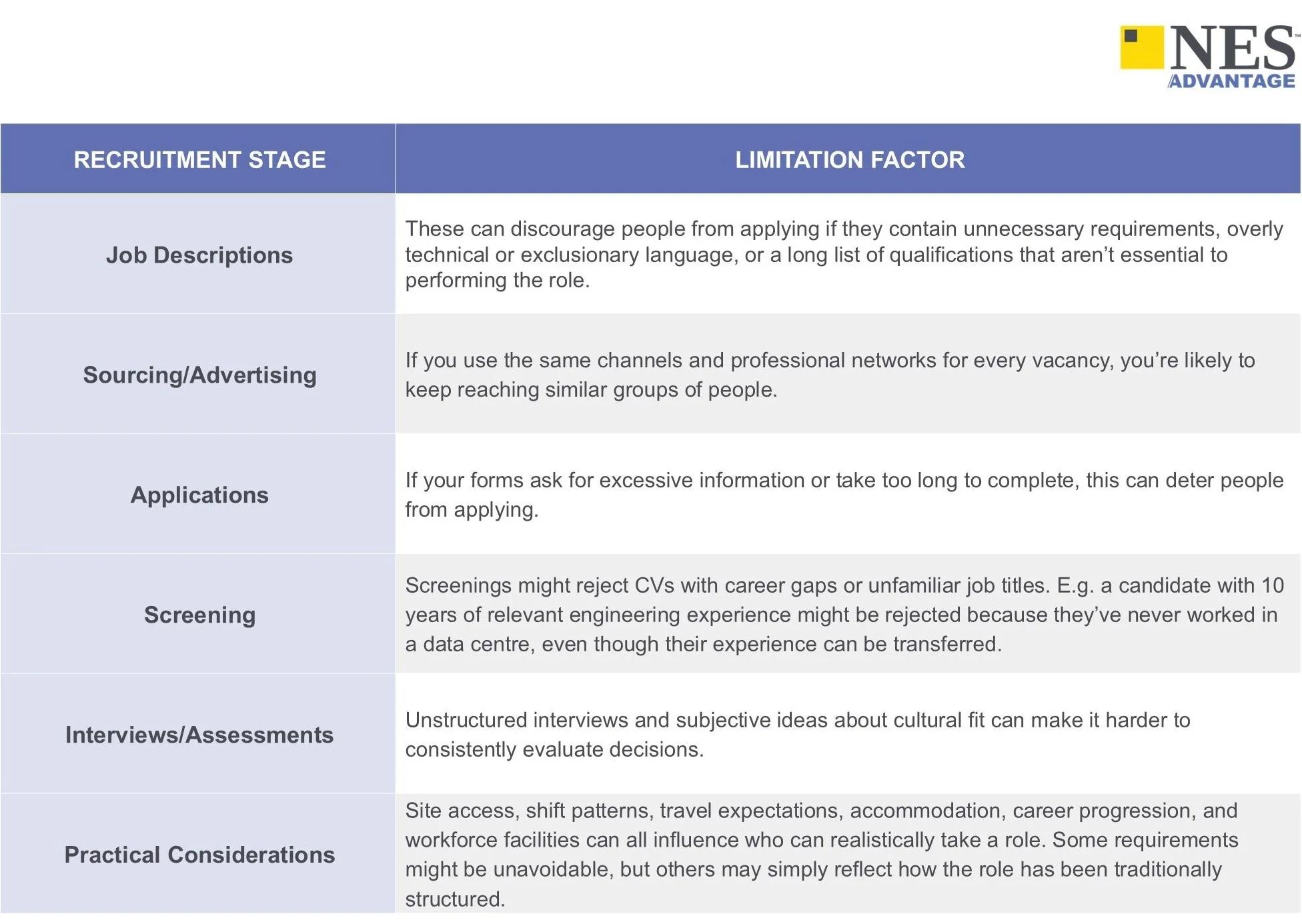
If this table highlights potential gaps in your recruitment process, our Diversity Diagnostic Report can help pinpoint where talented candidates may be overlooked and provide clear recommendations for improvement. Explore the report.
Inclusion must continue after hiring
While recruiting a wider range of people will initially help your business, issues will only rearise if you don’t give them reasons to stay.
In many organisations, progress in entry-level diversity doesn’t always carry over to mid-career and leadership positions. Structural and cultural barriers affect retention and promotion, creating what’s often called a “leaking pipeline”.
Data centre employers should pay attention to the daily experience of people working on-site. Shift patterns, travel, accommodation, uniforms, welfare facilities, parental responsibilities, religious needs and access requirements can all influence employee retention. Management behaviour matters as well. People need confidence that inappropriate conduct will be addressed. They need access to career development and fair promotion processes. And they should know how to request reasonable adjustments without worrying that doing so will damage their prospects.
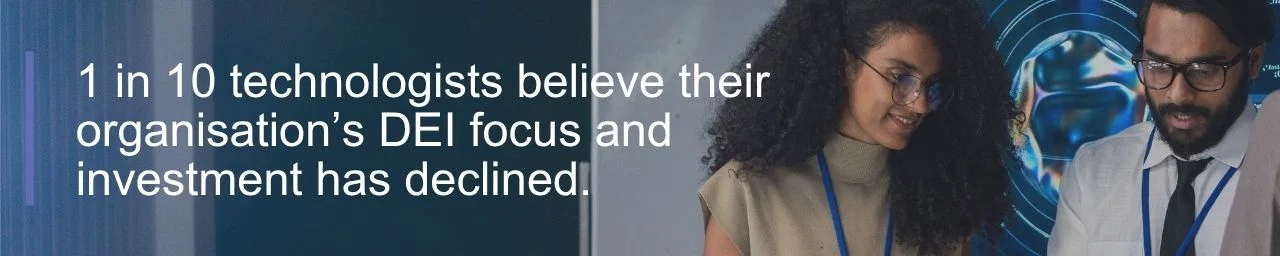
Harvey Nash found that 25% of women in tech believe the sector isn’t doing enough to encourage and support women, compared with 14% of male respondents. It also found that 1 in 10 technologists believe their organisation’s DEI focus and investment has declined over the previous two years.
Candidates assess the employer before they apply, and employees assess the employer after they join; therefore, claims about inclusion need to match the experience of working there.
The commercial case of DEI hiring
It’s not that diversity alone fixes operational problems; the value comes when different perspectives are included in decisions, supported by fair management and assessed through consistent processes.
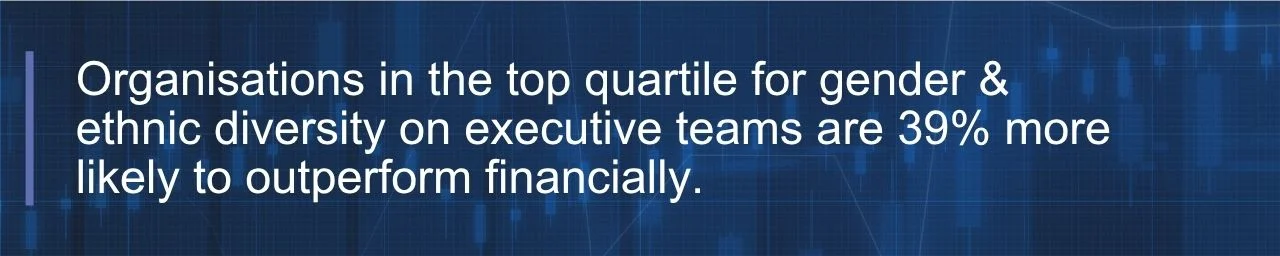
There’s evidence showing that having both gender and ethnic diversity in leadership is linked to better financial performance. McKinsey found that organisations in the top quartile for gender diversity on executive teams were 39% more likely to outperform companies in the bottom quartile financially, and the same for ethnic diversity. Even though this correlation shouldn’t be taken as proof that diversity causes better results in every organisation, it does offer a solid foundation for viewing diversity as a business consideration.
“Widening the pool by targeting a demographic that makes up 50% of the population but a fraction of the workforce is just good business.” - Charlotte Berry-Selwood, Chief Delivery Officer at AVK and co-founder of the Forum for Women in Data Centres.
For the data centre sector, if there are fewer candidates with conventional data centre backgrounds than there are job openings, then excluding people with transferable skills makes the recruitment challenge harder. It’s therefore necessary to have a more accurate definition of relevant experience and a recruitment process that gives overlooked candidates a fair chance to demonstrate their abilities.
What can you change in your recruitment process?
Start with the job itself. Separate essential technical skills from desirable experience. If previous data centre experience is genuinely necessary, keep it. If it’s simply familiar, consider whether transferable experience could meet the same requirement.
Check the language that you’re using in your job descriptions. Clear, specific descriptions can help candidates understand what’s exactly expected of them, while unnecessary jargon and long lists of requirements can create barriers before the recruitment process has even started.
Ask where your successful candidates have historically come from and whether those channels are reaching the wider workforce that you want to attract. Forming relationships with professional groups and communities connected to underrepresented talent can enable you to identify avenues that conventional recruitment channels might miss.
Structured interviews, consistent questions, and clear assessment criteria can make hiring decisions easier to compare and less dependent on subjective opinions.
What to look out for:
- If you know that women make up a reasonable share of applicants but drop out between application and interview, that tells you something different from having very few women apply in the first place.
- If candidates from a certain background reach the final interview stage but rarely receive job offers, you might need to investigate internal screening and approval processes.
- If people from underrepresented groups join but leave quickly, recruitment might not be your only issue, but also your employee value proposition or workplace expectations.
You need visibility across the whole process to identify patterns and understand where the barriers are. A useful DEI strategy gives recruitment teams information they can act on.
DEI works best when you can see where the problem is
It’s difficult to improve something you haven’t properly diagnosed. A diversity strategy can contain the right intentions and still produce limited results if you don’t know where candidates are being lost or how people experience your entire recruitment process.
NES Advantage’s Diversity Diagnostic Report is designed to examine recruitment through an inclusive lens, identifying potential barriers across areas such as recruitment marketing, job descriptions, selection, interviews, candidate progressions, diversity data and employer branding.
Want to understand where your hiring process could be excluding talent?
How NES Advantage Can Help You
NES Advantage combines recruitment expertise, workforce solutions, and consulting services across the engineering, energy, technology, and infrastructure sectors. Our Diversity Diagnostic Report can help you understand where your recruitment processes may be limiting your access to talent. You receive a RAG-rated diagnostic report, sector-specific benchmarks, accessibility recommendations, and a practical improvement plan to ensure you’re not missing out on great talent.
Review your diversity hiring strategy with us
If your data centre recruitment process keeps reaching the same people, it might be time to examine the paths candidates take before they meet your hiring team.
Contact us today to learn more about our Diversity Diagnostic Report and see where your recruitment process could be improved.
People also ask:
Is my hiring process inclusive enough?
If you're struggling to fill vacancies, receiving applications from a narrow range of candidates, or relying heavily on traditional hiring criteria, it may be worth reviewing whether your recruitment process is unintentionally creating barriers. Learn how to assess your recruitment process in our blog.