


Contingent workforce management is the way an organisation manages everyone who works for it but isn’t a permanent employee, including contractors, agency workers, freelancers, and consultants. It covers how those people are sourced, checked, approved, paid and released, and it gives every team involved a shared view of who is working and what they cost. Done well, it keeps flexible hiring affordable and compliant. When done badly, it hides tax risk and overspending. This guide explains how it works, who should own it, which software and services help, and the steps to set up a programme.
Main takeaways:
- Contingent workforce management is the structured control of every non-permanent worker, covering sourcing, classification, payment, and offboarding.
- HR, procurement, operations, and finance each hold a piece of the process, so one named owner and a small steering group make the difference.
- Economist Impact’s 2025 research found that 74% of executives cite cost efficiency as a main reason for using external workers, and 62% cite access to specialist skills.
- A VMS or managed service is only successful once worker definitions, rates and approvals are clear, which makes a diagnostic a sensible first step.
Many businesses might manage a contingent workforce without giving it a name. A hiring manager needs a piping engineer for 9 months; a supplier sends CVs; a purchase order is raised; and work begins. While this process is relatively simple, the problem arises when it isn’t tracked correctly across the entire business, and suddenly you don’t know how many contractors are on site.
This gap is why flexible hiring, compliance, cost control, and supplier performance need to be carried out together. Economist Impact’s 2025 study of more than 2,000 C-suite executives, as summarised by SAP, found that 74% name cost efficiency as a main reason for using external workers and 62% name access to specialist skills. Both goals fall apart quickly when nobody can see the whole programme.
What is Contingent Workforce Management?
Contingent workforce management is the structured control of all non-permanent workers an organisation employs. It covers how those workers are found, classified, approved, paid, monitored, and released, with the aim of enabling leaders to see who is working for them, on what terms, and at what cost.
Who counts as a contingent worker?
A contingent worker is anyone who does work for a company without being a permanent employee on its payroll. Contractors, agency temps, freelancers, independent consultants and workers supplied under a statement of work all qualify. Workers engaged through an employer of record sit close by, and many programmes include them as well.
Why companies use contingent labour
Projects start and finish on timelines that permanent headcount can’t match. A shutdown, a commissioning phase, a data centre build or a product launch needs specific skills for a specific window, and hiring permanently for that window usually isn’t justifiable. External workers also let businesses test demand before committing to a fixed cost.

How Contingent Workforce Management Works
A working programme follows each person through around four stages. The details might vary by sector, though the stages generally stay the same.
Sourcing and onboarding
Work begins with a requisition that states the role, the duration, the budget, and the approving manager. The request then goes to a supplier panel, a master vendor or a direct sourcing pool, depending on the model. Our guide to contingent workforce management models explains how vendor-neutral, master vendor, and hybrid set-ups differ. Once someone is chosen, onboarding covers right-to-work checks, site inductions, security clearance and system access.
Compliance and classification
Every worker needs a status decision before day one. In the UK, public bodies and medium- and large-sized private-sector clients decide the employment status of contractors working through an intermediary. A wrong call can leave the client facing the tax and National Insurance bill. Outside the UK, the details differ, yet the principle holds that the organisation using the worker bears the risk of misclassifying them.
Assignment, tracking and payment
Once work starts, the programme records who’s on assignment, against which budget and until when. Timesheets are approved by the manager who sees the work. Expenses follow a policy, and invoices are matched to approved hours before anyone is paid. Extensions require fresh approval, as assignments can naturally become longer.
Offboarding and reporting
When the assignment ends, access is removed, and equipment is returned. Knowledge is handed over to whoever stays, the supplier receives feedback, and the data from the assignment feeds into reporting. The last step is the one most often skipped, but it matters because end dates, rates, and durations will help to determine future forecasts.
Who Owns Contingent Workforce Management?
Ask a room of HR, procurement, operations, and finance leaders who owns the contractor population, and you might get a handful of answers that point elsewhere.
- HR responsibilities: HR sets the engagement rules and keeps worker policies clear. It also links external hiring to workforce planning, and it’s well placed to spot a contractor who has quietly become a permanent fixture.
- Procurement responsibilities: Procurement owns the supplier panel, the contracts, the rate cards and the savings target. It negotiates terms and checks that suppliers deliver what they promised.
- Operations and business leader responsibilities: Operations and business leaders know what work needs doing and when. They raise the requisitions, approve timesheets and decide whether an extension is warranted.
Why cross-functional ownership matters
Finance and legal have a stake too, which is why more than one function is needed to hold the programme together. Confidence in procurement’s own workforce management skills fell to 43% in 2025, after standing at 51% the year before. The job has outgrown any single department. Signs you’re overspending on contractors highlight what can happen when responsibility is spread too thin.

Common Challenges and Risks
Common contingent workforce management challenges tend to emerge time and again; here’s a quick rundown:
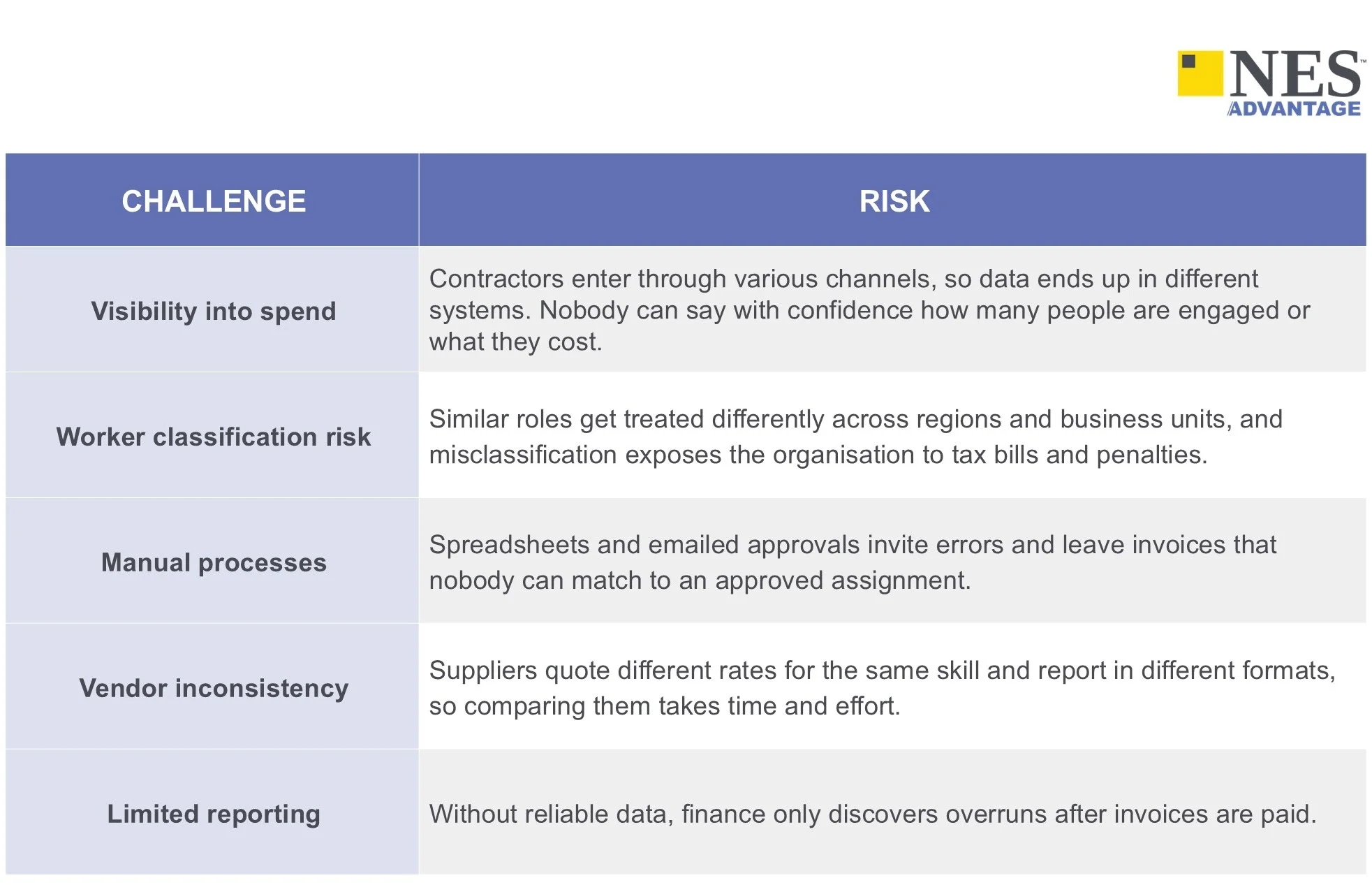
Software, Systems, and Services
When software helps
A vendor management system (VMS) becomes worthwhile when spreadsheets stop being trustworthy. It gives each worker one record, routes approvals, captures timesheets and produces reports by supplier, site and rate. SAP Fieldglass is one widely used example, and SAP presents it as a way of connecting procurement with external workforce management. Other platforms exist, and the right choice depends on your size, geography, and existing systems.
When a managed service makes sense
A managed service provider (MSP) takes on the daily running of the programme, including supplier management, requisition handling, reporting and compliance checks. It suits businesses whose internal teams lack the capacity or the specialist knowledge to do this well. Our MSP service is tailored, and clients can choose which parts to outsource and which to keep.
What to look for in a platform
Before signing anything, put these questions to every vendor:
- Can it hold a single definition of each worker type across every region?
- Does it report by supplier, site, rate, and approver without manual work?
- Does it connect to your HR and finance systems?
- Can hiring managers use it without a training course?
- Who owns the data if you change providers?
Technology also depends on the groundwork underneath it. A platform loaded with unclear work types and unbenchmarked rates will just produce tidy reports about messy decisions. Workforce technology advisory services can help you choose and implement the right tools.

Where Contingent Workforce Consulting Fits
Many organisations need clarity before they purchase anything. The NES Advantage contingent workforce consulting service starts with a diagnostic assessment covering current workforce analysis, compliance and risk, process efficiency, cost management and reporting, and technology. Our team identifies strengths, weaknesses, opportunities and threats, then delivers recommendations and a roadmap with timelines and milestones, presented to your stakeholders. The project runs through kick-off and assessment workshops, analysis and follow-up, and a presentation on findings.
The outcome shows how far better governance can take you and the point at which a VMS or MSP starts to pay for itself.
Best Practices
These habits separate programmes that run smoothly from the ones that need rescuing:
- Standardise policies: Write one set of definitions for worker types, engagement rules, extension limits and rate bands, and apply them in every region.
- Centralise visibility: Keep one record of every external worker, whatever route they arrived by.
- Define approval workflows: Decide who can approve an application, extension, a rate exception and a change of scope, and set thresholds so urgent requests still move quickly.
- Benchmark rates: Market data stops legacy rates from lingering. Salary and rate benchmarking services, alongside insights into competitive compensation for engineering roles, help you establish fair market rates.
- Track compliance: Check status determinations, right to work documents, insurance certificates and security clearances on a schedule, and keep the evidence where an auditor can find it.
- Review performance and spend regularly: Look at supplier performance, rate variance, invoice accuracy and assignment length every quarter, and act on what shows up.
Checklist for Implementation
- Set governance. Name a programme owner, agree a steering group and write down who decides what.
- Map worker categories. List every type of external worker in use today, including the ones engaged outside any formal process.
- Bring stakeholders together. Get HR, procurement, operations and finance to agree on goals and definitions before anyone chooses a tool.
- Choose tools and processes: Pick the VMS, MSP, or in-house approach that fits your volumes, then document the workflow end to end.
- Measure outcomes: Track spend against budget, time to fill, rate variance and compliance exceptions, and report them on a set schedule.
If you suspect your programme has more gaps than answers, a diagnostic might be the best next step.
Connect with NES Advantage
NES Advantage is a leading provider of outsourced solutions with decades of global workforce expertise. We can help you turn contingent workforce challenges into opportunities for improvement. Our teams work closely with you to assess current workforce programmes, uncover risks and inefficiencies, and develop practical strategies that deliver lasting value. Get in touch with our experts today and tell us where your contingent programme feels hardest to manage.